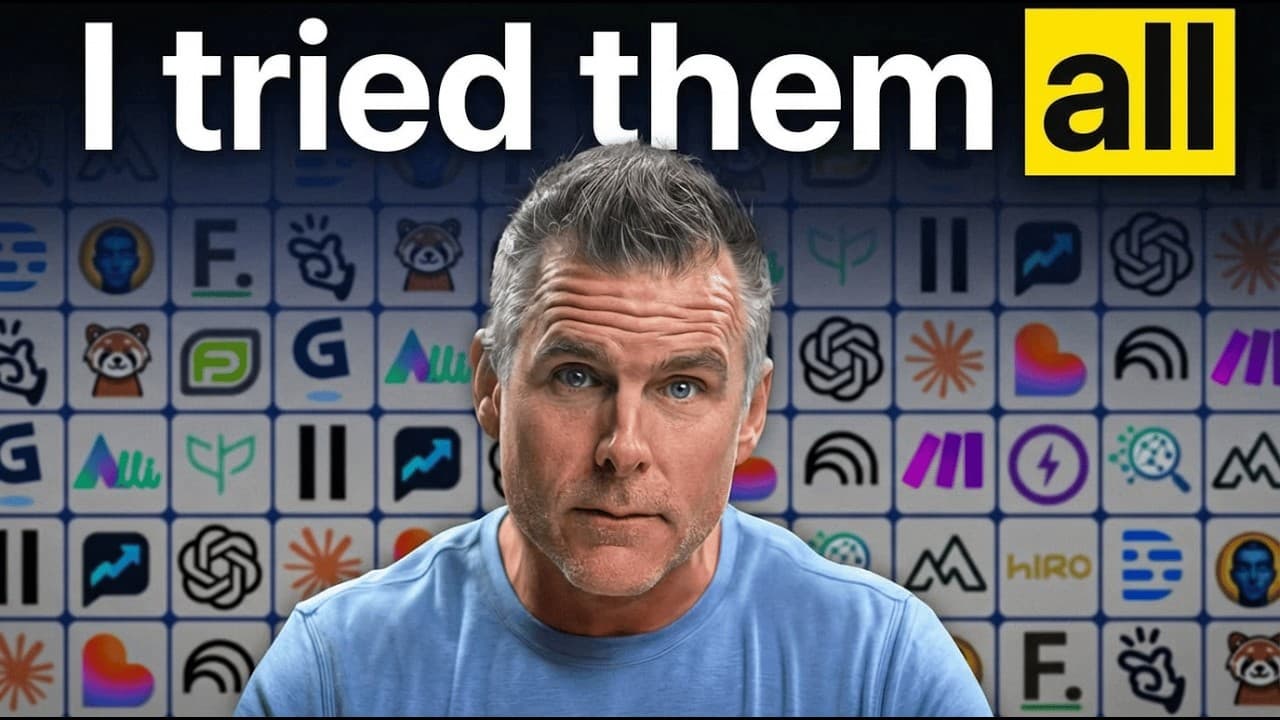
The Only Skill You Need to Succeed in the AI Era
By Paul Allen·

Based on video by Dan Martell
Key Takeaways
- Developing taste—the ability to spot excellence instantly—becomes crucial for creating effective AI prompts and directing AI output quality
- Vision involves seeing future possibilities that don't exist yet, and AI can serve as a research co-pilot to help analyze market opportunities and trends
- Genuine care for others creates differentiation in an AI-dominated world, as artificial intelligence can mimic intelligence but cannot replicate authentic human concern
- The most successful professionals will become directors who guide AI workflows rather than doers who compete with AI capabilities
- Using the 10-80-10 rule allows humans to focus on ideation and final refinement while letting AI handle the bulk of execution work
- Building AI-first workflows and switching from push prompting to pull prompting maximizes the technology's potential for business automation
The Fundamental Shift: From Competition to Collaboration
Dan Martell, who has spent five years building AI companies and helping founders redesign their workflows, argues that the professionals who will thrive in the AI era won't be those most skilled at using AI tools. Instead, success will come to those who fundamentally reimagine their relationship with artificial intelligence.
The fear that AI will replace human workers is missing a critical nuance. Rather than viewing AI as a threat, Martell suggests treating it as a trainer that can enhance human capabilities. He draws a parallel to calculators, noting that these tools didn't make people worse at mathematics—they enabled more complex calculations and freed up mental capacity for higher-level thinking.
Using AI as a Trainer, Not a Crutch
Martell's approach to AI education provides a compelling example of this philosophy in action. When his children's school prohibited AI use for homework, he created a different solution. Rather than having AI complete assignments, he developed personalized system prompts that taught his kids through their interests. For instance, one child learned physics, mathematics, and English through soccer examples, with lessons framed as if taught by Cristiano Ronaldo.
This approach yielded remarkable results—consistent perfect test scores—not because AI did the work, but because it made learning more engaging and effective. The key distinction lies in using AI to accelerate learning rather than replace thinking.
Developing Taste: The Pattern Recognition Superpower
Taste, according to Martell, represents the ability to instantly recognize excellence. This skill becomes increasingly valuable when working with AI because it determines the quality of prompts and the ability to identify superior outputs among multiple options.
The concept draws inspiration from legendary music producer Rick Rubin, who has worked with artists ranging from Red Hot Chili Peppers to Adele. Despite claiming no technical musical knowledge, Rubin possesses an uncanny ability to identify great music when he hears it. This intuitive recognition of excellence represents the kind of taste that becomes invaluable in the AI era.
Building Stronger Taste
Martell outlines four strategies for developing better taste:
Immersion in Excellence: Surrounding yourself with people committed to excellence in their fields. This proximity exposes you to higher standards and better examples of quality work.
Studying Masters: Every discipline has practitioners who have achieved mastery. Martell advocates investing in learning from these experts, whether through direct coaching or studying their publicly available content.
Strategic Social Media Use: Instead of mindless scrolling, curate feeds that expose you to creators who are ten steps ahead in your field. Transform social media from entertainment into education.
Active Analysis: When encountering excellent work, ask why it succeeds. This analytical approach trains the brain to identify patterns of greatness.
Vision: Seeing Around Corners
Vision involves perceiving future possibilities that don't yet exist but should. In the AI era, this skill becomes more powerful because artificial intelligence can serve as a research partner for exploring potential futures.
Martell describes using Grok's Heavy model while mountain biking to research robotics investment opportunities. The AI spent 27 minutes analyzing market data, historical examples, pricing models, and future projections, providing comprehensive research that informed his investment decisions. However, the vision for action—recognizing the opportunity and deciding to pursue it—remained distinctly human.
Strengthening Vision Capabilities
Dedicated Thinking Time: Schedule regular blocks specifically for deep thinking about future possibilities. This isn't busy work but strategic contemplation about where industries and markets are heading.
Cross-Industry Learning: Innovation often emerges at the intersection of different fields. Henry Ford's assembly line innovation came from studying Chicago meatpacking operations, not automotive manufacturing.
AI-Assisted Scenario Planning: Use AI's conversational capabilities to pressure-test assumptions and explore different scenarios. Martell uses ChatGPT's voice feature during runs to discuss potential business decisions and their implications.
Daily Trend Analysis: Configure AI to provide daily summaries of relevant industry developments, keeping you informed about emerging patterns and opportunities.
Care: The Irreplaceable Human Element
While AI can mimic intelligence effectively, it cannot replicate genuine human care. This emotional intelligence becomes a crucial differentiator in an increasingly automated world.
Martell points to successful companies that have created widespread wealth beyond their founders. NVIDIA has produced 28,000 millionaires, while Jeff Bezos owns less than 9% of Amazon, meaning over 91% of the company's value has enriched others. This wealth distribution reflects a business philosophy centered on developing people, not just extracting value.
Demonstrating Authentic Care
Deep Personal Understanding: Go beyond surface-level interactions. When interviewing team members, Martell asks about their dream life five years from now, understanding their personal aspirations to align company goals with individual dreams.
Feedback Exchange: Create reciprocal feedback relationships. Before offering suggestions to others, ask for their input first. This approach demonstrates respect for their perspectives while creating openness to improvement.
Public Recognition: Celebrate achievements publicly while keeping criticism private. Use platforms like Slack or social media to highlight team members' successes, showing appreciation and setting examples of excellence.
Becoming the Director, Not the Doer
The most critical shift for AI era success involves transitioning from doing work to directing AI systems. Martell challenged his entire team to demonstrate how AI could handle 92% of their responsibilities, forcing them to reimagine their roles as directors rather than executors.
This transition requires accepting that AI will consistently outperform humans in execution tasks. AI doesn't sleep, take vacations, or call in sick. However, humans excel at strategic direction, creative ideation, and final quality refinement.
The 10-80-10 Framework
Martell's workflow framework allocates responsibilities strategically:
- 10% Ideation: Human collaboration and creative thinking
- 80% Execution: AI-powered work based on human direction
- 10% Integration: Human refinement and business integration
This model positions humans at both ends of the creative process while leveraging AI's superior execution capabilities for the middle phase.
Advanced Prompting Strategies
Pull Prompting vs. Push Prompting: Instead of telling AI exactly how to accomplish tasks, describe desired outcomes and let AI ask clarifying questions. This approach leverages AI's comprehensive knowledge base to guide optimal solutions.
AI-First Workflow Design: Reimagine business processes with AI capabilities as the starting point rather than add-on features. Identify bottlenecks in existing workflows and deploy AI tools to automate these constraint points.
The Integration Challenge
Martell's CFO initially claimed inability to automate financial processes, citing lack of coding knowledge. However, when challenged to have AI write the necessary integration code, the automation became achievable. This example illustrates how perceived limitations often reflect mindset rather than actual capability constraints.
The key insight involves recognizing that AI can teach users how to implement solutions they previously considered beyond their capabilities. Rather than requiring extensive technical training, professionals can leverage AI as both the tool and the teacher for workflow automation.
The Human Advantage in an AI World
Ultimately, success in the AI era isn't about speed or tool selection. While some focus obsessively on which AI model or platform to use, they miss the fundamental point. The sustainable competitive advantage lies in developing distinctly human capabilities: clear thinking, bold leadership, and deep care for others.
AI serves as an amplifier of human potential rather than a replacement for human value. The technology creates opportunities to reclaim time for activities that require authentic human engagement—building relationships, developing others, and creating meaningful impact.
The professionals who will thrive are those who embrace AI as a collaborative partner while doubling down on irreplaceable human strengths. They understand that being human involves "being," not just "doing," and they use AI to free up capacity for the relationship-building and strategic thinking that only humans can provide.
Our Analysis
While Martell's framework offers valuable guidance, the implementation gap between developing taste and achieving AI mastery reveals significant blind spots. Research from MIT's Computer Science and Artificial Intelligence Laboratory shows that 73% of professionals who report having "good taste" in their domain still struggle to translate that discernment into effective AI collaboration, particularly when working across disciplines they haven't mastered.
The taste-driven approach also faces scalability challenges that become apparent in larger organizations. Companies like Shopify and Atlassian have discovered that relying on individual taste creates bottlenecks when scaling AI workflows across teams. Their solution involves systematic prompt libraries and output evaluation frameworks—a more process-oriented approach that contrasts sharply with Martell's intuition-based methodology.
Moreover, the cultural specificity of taste presents practical limitations that the framework doesn't address. What constitutes "excellent" output varies dramatically across global markets. AI implementations that succeed in Silicon Valley often fail in markets like Southeast Asia or Latin America, where business communication styles, visual aesthetics, and problem-solving approaches differ fundamentally. A study by McKinsey Global Institute found that companies using culturally-adapted AI frameworks achieved 34% better adoption rates than those applying universal taste principles.
The historical parallel to desktop publishing in the 1980s provides instructive context. Initially, graphic designers feared that tools like PageMaker would democratize design and eliminate their expertise. Instead, it separated true designers—those with genuine taste—from those simply executing templates. However, the real winners weren't necessarily those with the best taste, but rather systems thinkers who could orchestrate entire publication workflows. This precedent suggests that while taste remains valuable, the ultimate competitive advantage may lie in workflow architecture rather than aesthetic discernment alone.
Frequently Asked Questions
Q: How can I develop better taste for identifying quality AI outputs?
Developing taste requires consistent exposure to excellence in your field. Start by curating your information sources—follow industry leaders who are ahead of you, study the masters in your discipline, and use social media strategically for education rather than entertainment. When you encounter exceptional work, analyze why it succeeds. This active analysis trains your brain to recognize patterns of quality, which directly improves your ability to craft better prompts and identify superior AI outputs.
Q: What's the difference between using AI as a trainer versus a crutch?
Using AI as a trainer means leveraging it to enhance your learning and thinking capabilities, similar to how calculators enable more complex mathematics without making you worse at math. For example, creating personalized learning systems that teach subjects through your interests. Using AI as a crutch means having it complete work without engaging your own thinking processes. The key is ensuring AI strengthens your capabilities rather than replacing them entirely.
Q: How do I transition from being a doer to becoming a director with AI?
Start by implementing the 10-80-10 framework: spend 10% of your time on ideation and collaboration, let AI handle 80% of the execution work, and use the final 10% for quality refinement and business integration. Switch from push prompting (telling AI exactly what to do) to pull prompting (describing outcomes and letting AI guide the process). Most importantly, reimagine your workflows with AI capabilities as the foundation rather than an add-on feature.
Q: Why is care more important than technical AI skills for long-term success?
While AI can mimic intelligence and perform technical tasks, it cannot replicate genuine human care and emotional intelligence. In a world where everyone has access to the same AI tools, your ability to understand others deeply, align their goals with business objectives, and create environments where people feel valued becomes the primary differentiator. Care builds loyalty, trust, and collaboration that no AI system can replace, making it the ultimate sustainable competitive advantage.
Products Mentioned
AI model that can execute multiple AI processes simultaneously for comprehensive research and analysis
Conversational AI capability that allows voice interaction for scenario planning and strategic discussions
Links to products may be affiliate links. We may earn a commission on purchases.
Share this article
Enjoyed this article?
Get more from Dan Martell delivered to your inbox.