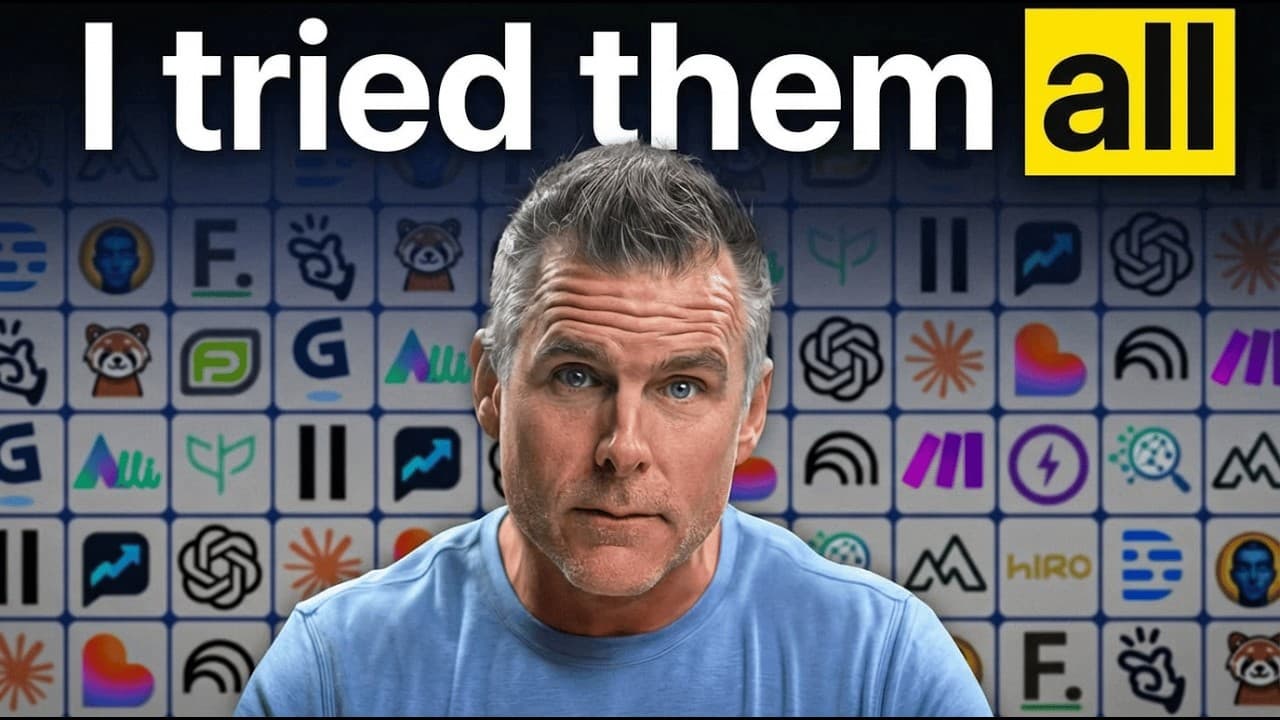
If I Wanted to Build a $10M AI Business (Zero Employees), I'd Do This
By Paul Allen·

Based on video by Dan Martell
Key Takeaways
- The future of business belongs to one-person companies using AI agents instead of large teams of employees
- Success starts with identifying painful problems in growing markets, not falling in love with AI technology
- Build and validate manually first, then create clickable prototypes before developing the actual product
- Use AI tools like Manis to build functional MVPs in minutes rather than months of traditional development
- Scale through AI automation and workflows, not by hiring more people
- Focus on high-level decisions and system design rather than managing teams and day-to-day operations
The Revolutionary Shift in Business Models
Dan Martell, a serial entrepreneur who has built and sold multiple software companies, believes the business world is experiencing its most significant transformation since the early 2000s. Leading AI experts worldwide are predicting that the next wave of billion-dollar companies won't require hundreds or even dozens of employees—they'll be built and operated by a single person leveraging AI agents.
This represents a fundamental departure from traditional business scaling methods. The old model involved having an idea, hiring people, paying substantial salaries, managing chaos, and scaling by adding headcount. The new paradigm focuses on identifying bottlenecks, automating them using AI, and watching complexity shrink as revenue grows.
In this new world, entrepreneurs don't do the work—they design the systems that do the work. As Elon Musk describes it, they're "building the machine that runs a machine." This shift allows business owners to focus on high-level strategic decisions rather than managing calendars and coordinating teams.
Step 1: Identifying Painful Problems Worth Solving
The biggest mistake AI entrepreneurs make is falling in love with technology rather than customer problems. Martell emphasizes the importance of finding "must-have" solutions—painkillers rather than vitamins. These are problems that cause genuine pain and urgency, where customers actively seek solutions and are willing to pay for them.
Martell shares a cautionary tale from his company Flowtown, where he initially targeted the wrong customer segment. Despite having a solid marketing tool, he was selling to small businesses when he should have been targeting the agencies those businesses hired. This misalignment nearly killed the company, highlighting the critical importance of proper customer identification.
Finding the Right Pain Points
To identify valuable problems, entrepreneurs should focus on growing markets where AI and automation can make significant impacts. Industries like real estate, healthcare, and coaching are experiencing rapid growth and transformation, creating abundant opportunities for innovative solutions.
Martell recommends using AI tools like Manis to conduct market research. These tools can analyze your background and interests to suggest promising problem areas. The key is to call potential customers and ask for advice rather than trying to sell immediately. This counterintuitive approach—"If you call to try to sell them something, you'll get advice. If you call for advice, you'll get a sale"—opens doors and provides genuine insights into customer pain points.
The validation process requires speaking with at least ten people to understand their challenges and help design initial product specifications. These conversations are crucial because they reveal problems customers are already spending money to solve, putting you 80% of the way toward a viable business.
Step 2: Manual Problem Solving Before Automation
Before building any technology, successful AI entrepreneurs solve problems manually. This approach allows them to get paid while learning the necessary steps and processes that will eventually be automated. The focus should be on understanding workflows rather than getting excited about features.
Martell illustrates this principle through his friend Matt's company, Precision. This powerful platform analyzes business data and provides actionable insights for problem resolution. However, the first version wasn't a sophisticated AI-powered system—it was a spreadsheet. Matt used this simple tool to validate customer problems, create a group of early adopters, and simulate the entire product experience before writing a single line of code.
This manual approach mirrors successful funding models like Kickstarter and Indiegogo, where customers pay before receiving products. The same principle applies to consulting and done-for-you services—people are willing to invest in solutions before they're fully developed.
Creating Your Initial Offer
To sell the manual version of your solution, you need a structured one-page offer containing five essential elements:
- Problem: The specific pain point your customers face
- Promise: The transformation they'll receive
- Timeline: How quickly you can solve their problem
- Price: The investment required
- Guarantee: Your commitment to results
An example offer might read: "Stop losing customers—we'll clean your database and provide insights for optimal next steps in 30 days for $2,500/month, or your money back."
Once you've crafted your offer, contact the ten customers from your initial research. They'll be eager to hear what you've learned from other conversations, making them receptive to your early adopter program. When they purchase, solve their problems manually using simple tools like spreadsheets, virtual assistants, or helpful partners.
Step 3: Building Clickable Prototypes
After successfully solving problems manually and generating revenue, it's time to create a prototype—but not a functional product. Martell emphasizes building a "clickable prototype" that simulates the user experience without actually working. This "Wizard of Oz" approach allows you to test concepts without significant development investment.
Martell used this strategy with Flowtown, presenting a convincing prototype to potential customers. When people tried to sign up, the team explained that high demand had overloaded their servers, placing interested customers on a waiting list. This approach validated customer understanding, willingness to pay, and solution preferences without building anything functional.
Modern AI-powered tools like Figma, UXpilot.ai, and Visly.ai can create sophisticated mockups in seconds. The key is keeping complexity to a minimum—complexity kills more businesses than competition.
Prototype Development Process
The prototype creation process involves three steps:
- Sketch the flow on paper: Map out what users will see and experience
- Use AI design tools: Describe your vision in plain English to generate screens
- Test with customers: Show the prototype to five new customers and record their reactions
Pay attention to what users click, what questions they ask, and how they navigate the interface. These insights are far more valuable than weeks of isolated development work. Five customer calls will teach you more than five weeks of coding.
Step 4: Building Your Minimum Viable Product
Once your prototype has been validated, it's time to build a functional MVP. The key is avoiding over-complication by focusing on the minimum features that deliver value around the core problem. Martell reminds entrepreneurs that Facebook started with one college and one function, while Amazon began with just books. You don't need to be everything to everyone.
When customers request additional features—custom reports, advanced permissions, or white labeling—resist the temptation to accommodate every request. Instead, document these requests and ask whether they'll impact 80% of your current users. If not, politely decline and stay focused on your core offering.
No-Code Development with AI
Martell demonstrates how to build an MVP using Manis.AI, an AI-powered development platform that can create full-stack applications from simple prompts. The process involves:
- Accessing the "develop apps" feature in Manis.AI
- Using a specific prompt template that includes your core promise and required screens
- Letting the AI build the entire application, including frontend, backend, and database
- Iterating based on feedback, treating the AI like an intern who can implement changes
The prompt should focus on core functionality—login, data input, and output screens—while explicitly avoiding complex features. By telling the AI to "implement the simplest version" when uncertain, you maintain focus on essential functionality.
Step 5: Scaling with AI Agents, Not Employees
The final step involves scaling through AI automation rather than hiring additional team members. Martell challenges entrepreneurs to "dare to scale your business by adding the least amount of people as possible." This approach creates massive leverage with minimal headcount.
The scaling process follows three distinct phases:
Zero to $100K: You handle everything personally while using AI to move faster and more efficiently.
$100K to $1M: Begin building systems that AI can run automatically—onboarding, support, operations, and financials.
$1M to $10M: Stack AI agents and workflows, involving yourself only when decisions require human judgment.
Martell's venture capital firm, Martell Ventures, launches new AI companies every four weeks. One recent launch achieved $83,000 in monthly recurring revenue with just the founder and two part-time contractors. The entire operation runs on workflows and AI agents, allowing the founder to focus exclusively on strategy and sales while everything else happens automatically.
The Future of Business Operations
This transformation represents more than a technological shift—it's a fundamental reimagining of business operations. The traditional bragging rights about team size are becoming obsolete, replaced by pride in revenue generation with minimal human resources.
The approach requires conversations with real people and a systematic methodology rather than deep technical knowledge. Success comes from having the courage to operate differently and the discipline to focus on system design rather than task execution.
Martell emphasizes that when AI can solve virtually any problem, the real challenge becomes knowing which problems to solve. This is why he advocates for a narrow focus and systematic execution, preventing entrepreneurs from getting in their own way by solving the wrong problems at the wrong time.
The one-person AI business model isn't just about efficiency—it's about creating unprecedented leverage. By designing systems that work autonomously, entrepreneurs can achieve massive scale while maintaining complete control over their operations and decision-making processes.
Our Analysis
While Martell's vision of AI-powered one-person companies holds significant promise, emerging regulatory frameworks pose challenges he doesn't address. The EU's AI Act, which came into full effect in 2024, requires companies using AI systems in high-risk applications to maintain detailed documentation and human oversight—potentially undermining the "zero employee" model for businesses in healthcare, finance, or recruitment sectors.
More critically, market saturation dynamics suggest a narrowing window for this approach. Analysis from CB Insights shows that AI-enabled SaaS funding peaked at $47.3 billion in 2023 but contracted 31% through 2024, indicating investors are becoming more selective about AI business models. The "painful problems" Martell advocates targeting are increasingly being identified by well-funded teams using similar methodologies, creating intense competition even in validated markets.
The manual validation approach also faces practical scalability limitations depending on founder experience level. While seasoned entrepreneurs like Martell can leverage existing networks for customer discovery, first-time founders often lack the credibility to secure ten meaningful customer conversations. Recent data from First Round Capital indicates that technical founders without prior industry connections take 3-4x longer to validate problems compared to those with established relationships.
Furthermore, Martell's framework overlooks geographic constraints that significantly impact viability. His emphasis on industries like real estate and healthcare works primarily in developed markets with digital infrastructure. Entrepreneurs in emerging markets face different regulatory environments, payment processing limitations, and customer behavior patterns that make direct application of this model problematic.
The integration complexity between multiple AI tools also presents hidden costs. While Manis and similar platforms promise rapid MVP development, connecting these systems with CRM, payment processing, and customer support tools often requires technical expertise that contradicts the "anyone can do this" narrative.
Frequently Asked Questions
Q: How do I know if a problem is worth solving with AI?
A problem is worth solving if customers are already spending money trying to fix it and it causes them genuine pain rather than minor inconvenience. Look for "must-have" solutions in growing markets like healthcare, real estate, or coaching. The key indicator is urgency—customers should feel compelled to solve the problem rather than viewing it as a nice-to-have improvement.
Q: What if I don't have technical skills to build an AI business?
Technical skills aren't required for building successful AI businesses. The process starts with conversations, manual problem-solving, and systematic validation before any coding begins. Modern AI tools like Manis.AI can build functional applications from simple English descriptions, making technical implementation accessible to non-programmers. Focus on understanding customer problems and designing solutions rather than learning to code.
Q: How much money do I need to start a one-person AI business?
You can start with minimal capital by following the manual-first approach. Begin by solving problems manually using simple tools like spreadsheets and get paid for this service. This generates revenue while you learn the processes that will eventually be automated. Many successful AI businesses start with less than $1,000 in initial investment, primarily for tools and basic infrastructure.
Q: How long does it take to build a profitable one-person AI business?
The timeline varies depending on market selection and execution speed, but the systematic approach can generate revenue within weeks rather than months. Since you start by solving problems manually and getting paid immediately, revenue generation begins before any product development. The key is following the six-step process methodically rather than trying to skip steps or build everything at once.
Products Mentioned
AI-powered development platform that can create full-stack applications from simple text prompts, including frontend, backend, and database components
Design and prototyping tool that can create mockups and user interfaces for applications
AI-powered tool for creating user experience mockups and prototypes
AI design tool that can generate application screens and interfaces from plain English descriptions
Dan Martell's marketing software company that helped businesses identify and connect with potential customers
Business intelligence platform that analyzes company data and provides actionable insights for problem resolution
Links to products may be affiliate links. We may earn a commission on purchases.
Share this article
Enjoyed this article?
Get more from Dan Martell delivered to your inbox.