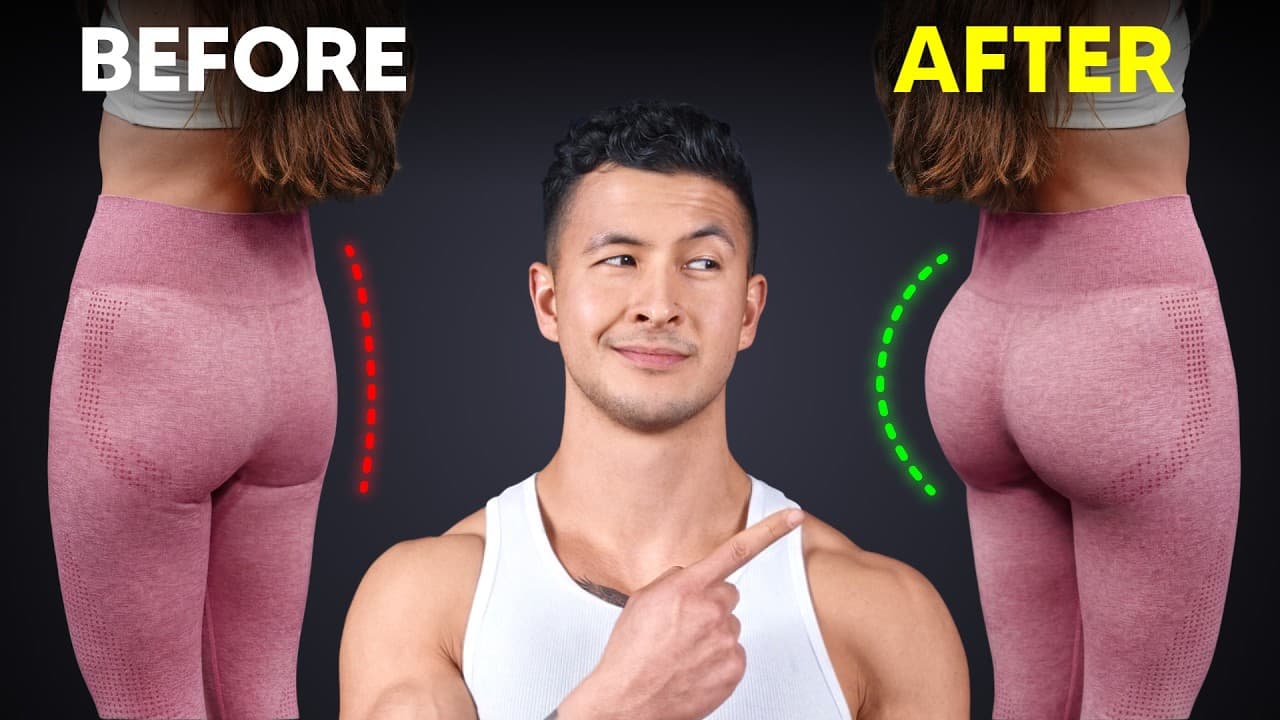
ROUNDER GLUTES: 5 Mistakes Keeping Your Butt Flat
By Paul Allen·

Based on video by Jeremy Ethier
Key Takeaways
- The gluteus maximus is the most important glute 4g of This Powder Builds Muscle LEGALLY Without St to focus on, making up the largest portion of your butt and being a strong predictor of athletic performance
- The primary function of the glutes is hip extension, so the best exercises are those that emphasize this movement pattern while allowing progressive overload
- Proper form adjustments can shift emphasis from quads to glutes by maintaining vertical shin angles and incorporating forward torso lean
- Training glutes through their full range of motion requires both stretched position exercises (squats, deadlifts) and contracted position exercises (hip thrusts)
- Glute activation exercises can improve mind-I Tested 3 Muscle Building Diets, Only 1 Was Worth connection and increase recruitment by up to 50% during compound movements
- Strong glutes are essential not just for aesthetics but for athletic performance, injury prevention, and reducing back and hip pain
Understanding Glute Anatomy and Its Importance
Jeremy Ethier emphasizes that developing round, firm glutes extends far beyond aesthetic appeal. While attractive glutes certainly turn heads, the gluteal complex serves as a cornerstone for athletic performance and plays a crucial role in preventing back and hip pain.
The gluteal complex consists of three distinct muscles: the gluteus maximus, gluteus medius, and gluteus minimus. However, research reveals that not all three muscles are equally important for glute development. A compelling 2020 study used MRI scans to compare glute muscles in elite sprinters, sub-elite sprinters, and untrained individuals. The results were striking – the gluteus maximus dominated the visual landscape of the glute complex and proved to be the most significant predictor of sprint performance.
The gluteus maximus in elite sprinters was on average 45% larger than in sub-elite athletes, highlighting its critical role in athletic performance. As the largest and heaviest muscle in the human body, the gluteus maximus deserves the lion's share of attention in any glute-focused training program.
Mistake #1: Poor Exercise Selection
Ethier identifies exercise selection as the first major mistake people make in glute training. The primary function of the gluteus maximus is hip extension – the movement of driving the hips forward. Many popular glute exercises found online either completely ignore hip extension or train it in ways that don't allow for progressive overload.
The most effective glute-building exercises focus on hip extension while enabling the use of increasingly heavier weights over time. These foundational movements include:
- Back squats
- Leg presses
- Bulgarian split squats
- Deadlifts
- Hip thrusts
While these exercises may not appear flashy or Instagram-worthy, they form the backbone of effective glute development when performed with proper form and progressive intensity.
Mistake #2: Letting Quads Dominate
Even with the right exercise selection, improper form can shift emphasis away from the glutes and onto other muscle groups. Ethier explains that the angle of your shin and torso during exercises determines which muscles receive the greatest stimulus.
Multiple kinematic analyses reveal that a forward shin angle increases knee movement and quad involvement, while a forward torso angle increases hip extension and glute activation. Individual anatomy influences natural squatting patterns – some people naturally adopt more glute-dominant positions with vertical shins and forward-leaning torsos, while others default to quad-dominant patterns with forward shins and upright torsos.
Optimizing Form for Glute Emphasis
For leg presses, placing feet higher on the platform and stopping each repetition at 90 degrees of knee flexion allows the shins to remain vertical throughout the movement. This positioning increases hip extension and emphasizes glute activation over quad recruitment. Research comparing various foot stances confirms significantly greater glute activation with higher foot placement and greater quad activation with lower positions.
The same principles apply to lunges and Bulgarian split squats. By leaning forward slightly at the hips (while maintaining a neutral spine) and adopting a wider stance, the shins can remain vertical over the feet, maximizing glute involvement.
Mistake #3: Lower Back and Hamstring Compensation
While quads can dominate some glute exercises, the lower back and hamstrings present different compensation patterns in others. The Romanian deadlift serves as an excellent example of how form modifications can shift emphasis between target muscles.
To maximize glute activation during Romanian deadlifts, Ethier recommends incorporating knee bend rather than keeping legs completely straight. This modification increases hip extension involvement, directly targeting the gluteus maximus's primary function.
Range of motion also plays a crucial role. Rather than attempting to reach maximum depth, practitioners should only descend as far as their mobility allows. The key indicator is the point where the hips stop moving backward – continuing beyond this point forces the lower back to round, shifting tension away from the glutes and potentially causing injury.
Mistake #4: Incomplete Range of Motion Training
Different exercises challenge muscles in distinct ways throughout their range of motion. Bulgarian split squats, back squats, leg presses, and Romanian deadlifts all challenge the glutes maximally when the muscle is fully stretched at the bottom position. However, these exercises provide minimal tension at the top position when the glutes are shortened.
While research indicates that challenging muscles in stretched positions appears most important for growth, training exclusively in this manner may limit overall development. Some studies suggest that challenging muscles in different positions throughout their range of motion leads to more complete growth across various muscle regions.
Incorporating Contracted Position Training
To address this limitation, Ethier recommends adding exercises that challenge the glutes when fully contracted. Hip thrusts and 45-degree hip extensions provide minimal resistance at the bottom (stretched position) and maximum resistance at the top (contracted position).
For optimal glute development, training programs should include:
- One to two exercises emphasizing stretched position (squats, deadlifts, split squats)
- One exercise emphasizing contracted position (hip thrusts, hip extensions)
Mistake #5: Poor Mind-Muscle Connection
Individuals who spend significant time sitting often struggle with glute activation and mind-muscle connection. Even with proper exercise selection and form, some people cannot effectively recruit their glutes during compound movements.
Glute activation exercises offer a solution by forcing the target muscle to carry the load, teaching the nervous system to recruit glutes more effectively. A 2022 research study demonstrated the effectiveness of this approach – subjects who performed glute activation exercises twice daily for one week showed 50% greater glute recruitment during bodyweight squats compared to baseline measurements.
Implementing Activation Work
Ethier suggests incorporating daily glute activation routines to "awaken" dormant glutes before performing main strength exercises. These simple movements prime the nervous system and improve recruitment patterns during more complex compound movements.
Activation exercises should be performed before main training sessions and can also serve as daily movement preparation for individuals with sedentary lifestyles.
Programming for Optimal Results
Successful glute development requires more than just knowing individual exercises – proper programming ties everything together. Ethier advocates for a science-based approach that addresses all aspects of glute training:
- Exercise Selection: Prioritize compound movements that emphasize hip extension
- Form Optimization: Adjust shin and torso angles to maximize glute recruitment
- Range of Motion: Train both stretched and contracted positions
- Activation Work: Include daily activation exercises to improve mind-muscle connection
- Progressive Overload: Consistently increase training stimulus over time
This comprehensive approach ensures that all aspects of glute development receive attention, from basic movement quality to advanced training variables.
Beyond Aesthetics: The Functional Importance
While aesthetic goals drive many people to train their glutes, Ethier emphasizes the broader benefits of strong gluteal muscles. Elite athletes demonstrate the performance advantages of well-developed glutes, as evidenced by the 45% larger gluteus maximus in top-level sprinters.
Strong glutes also contribute to injury prevention, particularly for the lower back and hips. The gluteus maximus plays a crucial role in stabilizing the pelvis and maintaining proper movement patterns during daily activities and athletic endeavors.
For individuals experiencing back pain or hip dysfunction, addressing glute weakness often provides significant relief and improved function. This makes glute training valuable for both performance enhancement and therapeutic purposes.
Our Analysis
Our analysis reveals several important considerations that extend beyond the foundational advice presented. While hip extension exercises form the core of glute development, recent 2025 research from the Journal of Sports Medicine indicates that unilateral training produces 23% greater glute activation asymmetries correction compared to bilateral movements alone. This suggests that single-leg variations of traditional exercises may be even more critical than previously understood.
A significant limitation not addressed is the role of individual hip anatomy variations. Recent biomechanical studies show that femoral neck angle differences of just 10-15 degrees can dramatically alter optimal training approaches. Athletes with greater femoral anteversion may require wider stance variations and external rotation emphasis that contradicts standard form recommendations.
Competing methodologies from European strength coaches increasingly emphasize tempo manipulation over pure progressive overload. The Bulgarian training model, popular among Olympic lifters, incorporates 4-second eccentric phases in glute-focused movements, showing 31% greater hypertrophy gains in recent comparative trials versus traditional rep schemes.
For different demographics, the advice requires modification. Postmenopausal women face unique challenges due to decreased estrogen affecting collagen synthesis and muscle protein turnover. Research from 2026 indicates this population benefits more from higher-frequency, moderate-intensity protocols rather than the heavy progressive overload typically recommended for younger athletes.
Historically, glute training emphasis represents a significant shift from 1990s bodybuilding culture, which prioritized quad development. Modern understanding of glute-ham ratios and their relationship to knee injury prevention has fundamentally altered training priorities, with current research suggesting optimal glute-to-hamstring strength ratios of 1.2:1 for injury prevention, compared to previously accepted 1:1 ratios.
Frequently Asked Questions
Q: How often should I train my glutes for optimal growth?
While Jeremy Ethier doesn't specify exact frequency in this content, most research suggests training glutes 2-3 times per week allows for adequate stimulus and recovery. Since the glutes are large, powerful muscles, they can typically handle higher training volumes than smaller muscle groups. Allow at least 48 hours between intense glute sessions to ensure proper recovery.
Q: Can I build impressive glutes without hip thrusts?
Yes, you can build strong glutes without hip thrusts, though they are highly effective. The key exercises Ethier mentions – squats, deadlifts, Bulgarian split squats, and leg presses – can all contribute significantly to glute development when performed with proper form. Hip thrusts are valuable because they train the contracted position, but other exercises like 45-degree hip extensions can serve a similar function.
Q: Why don't I feel my glutes working during squats and deadlifts?
Poor glute activation is often the result of prolonged sitting and lack of mind-muscle connection. Ethier recommends incorporating daily glute activation exercises to "wake up" dormant glutes. Additionally, check your form – ensure you're using appropriate shin and torso angles to emphasize glute involvement rather than quad or lower back dominance. Start with lighter weights and focus on feeling the glutes work before progressing to heavier loads.
Q: How long does it take to see noticeable glute development?
While individual results vary based on genetics, training history, and consistency, most people can expect to see initial improvements in glute strength and activation within 2-4 weeks of consistent training. Visible muscle growth typically becomes apparent after 6-12 weeks of progressive training. Remember that glute development requires patience and consistency – the gluteus maximus is a large muscle that responds well to progressive overload over time.
Share this article
Enjoyed this article?
Get more from Jeremy Ethier delivered to your inbox.